Recently, the research team led by Prof. Qiuliang Wang at the Institute of Electrical Engineering, Chinese Academy of Sciences (IEE, CAS), successfully developed a 35.6 Tesla all-superconducting magnet. Leveraging the National Major Science and Technology Infrastructure—Synergetic Extreme Condition User Facility (SECUF)—the team set a new world record for all-superconducting user magnets. This technological breakthrough represents an optimization and upgrade based on the 30 Tesla all-superconducting magnet previously developed by the IEE.
Verified by on-site expert testing, the magnet generated a central magnetic field of 35.6 Tesla with a usable bore of 35 millimeters. It is designed as a "user magnet" intended to support frontier research by scientific teams both domestically and internationally. This breakthrough establishes China's global leadership in the field of high-field all-superconducting user magnets.
This accomplishment marks a significant milestone in China's high magnetic field technology. It will provide essential extreme high-magnetic-field experimental conditions for cutting-edge research in material sciences, life sciences, and other disciplines. By enabling researchers to explore the unknown laws of the microscopic world, this facility is poised to accelerate major scientific discoveries and technological innovations in basic research and high-end equipment manufacturing, benefiting both China and the global scientific community.
High-field superconducting magnets are devices capable of generating strong magnetic fields with zero resistance under cryogenic conditions. Characterized by extremely high magnetic field intensity, stability, and homogeneity, as well as low energy consumption, they are core components in modern technology. These magnets hold immense application value in national major science infrastructure, advanced scientific instruments, high-end medical equipment, energy and transportation, and specialized national defense equipment. However, the development of high-field superconducting magnets involves multidisciplinary integration and faces multiple engineering bottlenecks. The process demands meeting rigorous standards for magnetic field intensity, stability, homogeneity, effective aperture, and long-term operational reliability, making the development process extremely challenging.
To address these technical challenges, the IEE research team developed the superconducting magnet system by overcoming key obstacles in design and construction. They innovatively proposed a comprehensive electromagnetic precision design theory for high-field high-temperature superconducting (HTS) magnets. Key technologies introduced include electromagnetic structure follow-up adjustment methods, multi-coil axial adaptive pre-loading, and partitioned screening current suppression. These innovations significantly enhanced the electromagnetic-mechanical safety margins of the magnet. Concurrently, the research team from the Institute of Physics, CAS, overcame difficulties related to HTS magnet health monitoring and precise magnetic field measurement under extremely low temperatures and high fields. This collaborative effort resulted in a leapfrog breakthrough in all-superconducting magnet performance.
Looking ahead, the IEE will further advance high-field superconducting magnet technology. The institute aims to provide internationally leading high-magnetic-field technical support for national major science infrastructure construction, advanced scientific instrument R&D, and national defense security, injecting strong technological momentum into the implementation of major national strategies.
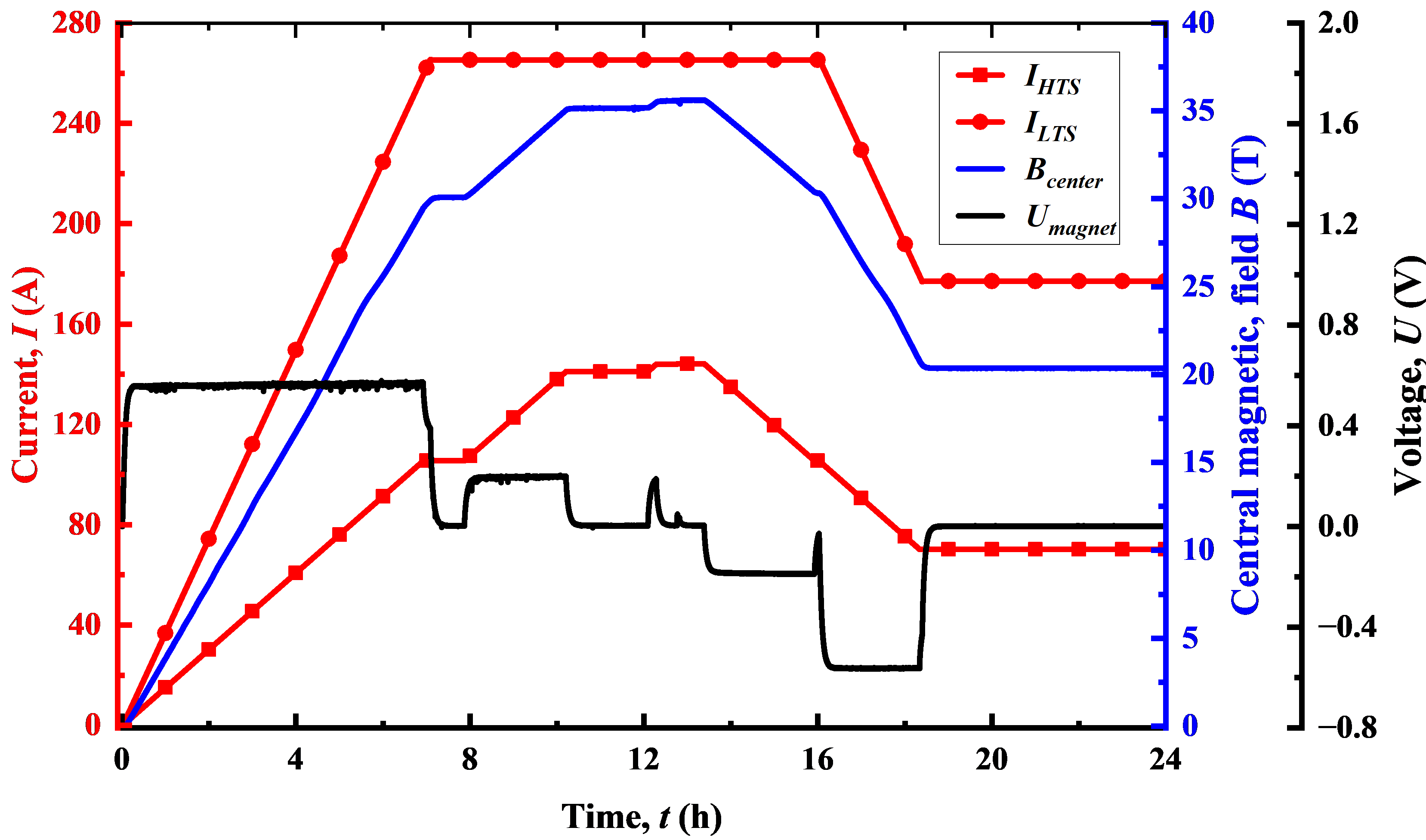
Excitation process of 35.6T whole superconducting magnet


